Reliability of industrial automation systems - sensor, connection and sealing as one system
In industrial automation, reliability is most often attributed to the quality of sensors. In practice, however, the stable operation of an installation depends on the entire connection path: the cable, the connector and the sealing elements. The connector is not a critical part of the process - its role is to provide the sensor with stable working conditions, without generating additional operational problems.
Real operating conditions - automotive and dusty environments
On production lines and in dusty zones of industrial halls, sensor connections are exposed to process dust and solid particles, vibration and micro-movements of machines, moisture (condensation and splashing), as well as technical oils and greases. In such conditions, what matters most is whether the connection maintains its tightness and electrical parameters over the long term, not only at the moment of installation.
Sealing ring - a key barrier against dust and water
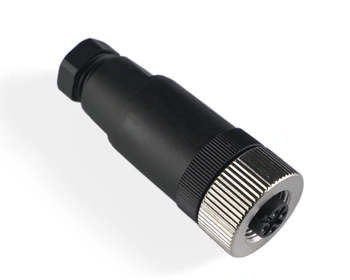
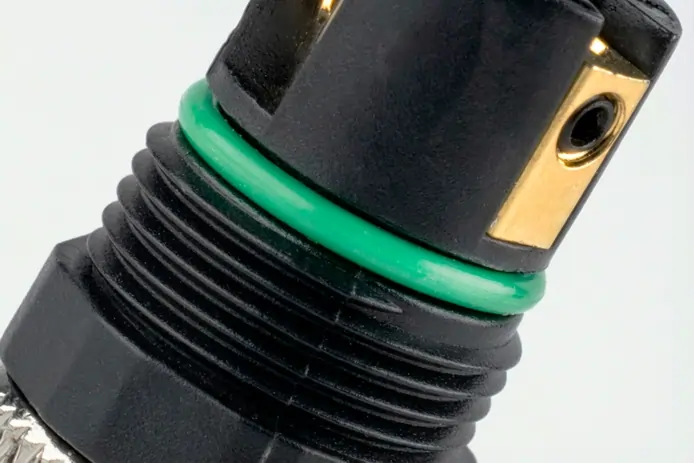
One of the most important structural elements of M8 and M12 connectors is the sealing ring made of NBR, working together with the face of the socket and the thread. In practice, it is the ring that:
- creates a tight barrier against dust and solid particles,
- protects the interior of the connector against moisture and water,
- compensates for minor alignment inaccuracies during assembly,
- retains flexibility over a wide temperature range,
- enables the actual maintenance of the IP67 protection rating throughout the entire service life.
In dusty and automotive environments, the quality of the seal determines whether the connection remains stable for months and years without maintenance intervention.
IP67 protection rating - what it means in practice
The IP67 (EN 60529) protection rating means full dust-tightness and protection against temporary immersion in water. For M8 and M12 connectors, the IP67 class is the result of the cooperation between the connector's design, the sealing ring and the correct tightening torque - not the thread alone.
Technical parameters that translate into reliability
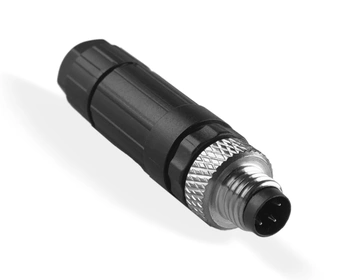
Mechanical and environmental parameters (M8 - example configuration)
- Thread: M8x1
- Connector type: male
- Number of contacts: 3
- Coding: A (A-coded)
- Housing type: straight
- Shielding: none
- Protection rating: IP67 (EN 60529)
- Temperature range: −40…+85 °C
- Durability: ≥ 100 mating cycles
- Tightening torque: 0.6 Nm
The parameters above show what a typical M8 configuration looks like in sensor applications. In practice, this specification translates into tightness and repeatability of assembly (ring + tightening torque), stable operation under varying temperature conditions, and durability suitable for permanent installations and servicing.
Electrical parameters
- Rated voltage: 60 V AC/DC
- Rated impulse voltage: 1500 V
- Rated current (40°C): max. 4 A
- Insulation resistance: ≥ 100 MΩ
- Contact resistance: ≤ 5 mΩ
The electrical parameters are matched to typical automation applications: sensors, PLC inputs/outputs and control signals. Gold-plated contacts ensure signal stability and resistance to oxidation, while high insulation resistance reduces the risk of leakage currents in more demanding environmental conditions.
Connection / wiring
- Connection method: screw terminals
- Cable outlet: 3.5–5 mm
- Wire cross-section: 0.14–0.5 mm²
Screw terminals make quick assembly and field servicing easier. The range of wires and cable outlet is compatible with typical sensor cabling, which speeds up upgrades and replacements during maintenance.
Materials
- Housing: PA
- Seal: NBR
- Contacts: gold-plated copper
- Metal parts: nickel-plated copper
- UL 94: HB
The materials used support the durability of the connection: PA provides mechanical strength and dimensional stability, NBR maintains the flexibility of the seal, and gold-plated contacts ensure low resistance and a stable signal over a long period.
Standards and compliance
- IEC 61076-2-101
- CE, RoHS
Installation and servicing - a maintenance perspective
Compatibility with popular cabling, the availability of M8/M12 variants (straight/angled, male/female) and the repeatable clamping of the ring thanks to the correct tightening torque translate into simple installation and quick servicing. A well-chosen connection stays in the background of the system's operation - and that is precisely why it genuinely supports production continuity.
Summary
The reliability of an industrial automation installation is the result of the consistent operation of the entire connection - the sensor, the cable, the M8 or M12 connector, the sealing ring and correct installation. In this system, the ring seal plays a key role in protecting against dust and water and in maintaining the IP67 class throughout the entire service life.
FAQ - M8 and M12 connectors in all configurations
What is the difference between M8 and M12 connectors?
M8 is used mainly in compact sensor applications, while M12 is more universal and commonly used in machine and automotive installations.
When should you choose M8, and when M12?
M8 is usually chosen when space saving and compact mounting near the sensor matter most. M12 works well in more universal machine installations and wherever the cabling is standardized across the entire line.
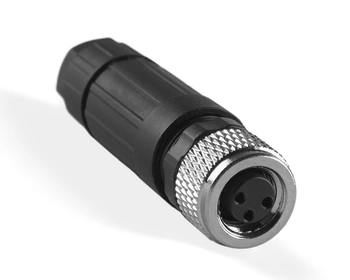
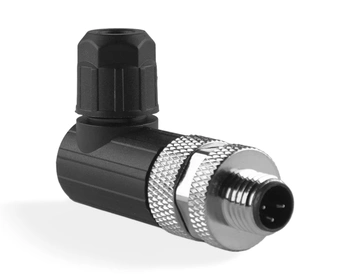
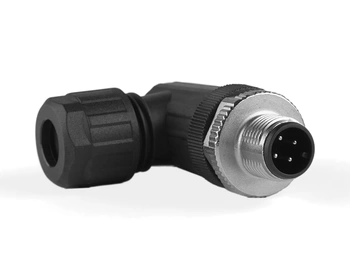
Are M8 and M12 connectors available in straight and angled versions?
Yes. Both standards are available in straight and angled versions. The choice depends on the machine's geometry and cable routing, not on differences in tightness or durability.
Are male and female versions available (M8 and M12)?
Yes. M8 and M12 connectors are available in male and female versions, which allows any installation configuration and makes upgrades easier.
Does the angled version seal worse than the straight one?
No. Tightness is determined by the sealing ring and the correct tightening torque, not the geometry of the cable outlet.
What role does the sealing ring play in M8 and M12 connectors?
The sealing ring forms a key barrier against dust and moisture. Working together with the socket and thread, it enables the actual maintenance of the IP67 protection rating and the stability of the connection over the long term.
Is IP67 sufficient in a dusty automotive environment?
Yes. IP67 provides full dust-tightness and effective protection against moisture in typical industrial and automotive conditions.
What is the significance of the tightening torque (e.g. 0.6 Nm for M8)?
The correct tightening torque ensures proper compression of the sealing ring, which directly affects the tightness and durability of the connection.
Are M8 and M12 connectors suitable for permanent installations?
Yes. A durability of at least 100 mating cycles means they are intended mainly for permanent installations and occasional servicing.
Where are M8 and M12 connectors most commonly used?
They are most commonly found on automotive assembly lines, in dusty production zones, on conveyors, at machining stations and in sensor installations operating in continuous mode.